LogoNewFace
Models
Skills
Features
AI Image GeneratorAI Video GeneratorVideo to AudioVideo Subtitle RemoverProduct Detail PageAI TikTok Ads GeneratorAI UGC Video CreatorAI Video Ad GeneratorReal Estate Video AdsAI YouTube Shorts MakerAI UGC Video GeneratorUGC Product AdsGoogle Ads UGC VideoSkincare Video AdsSkincare UGC VideosWomen's Fashion AdsCosmetics Video AdsDTC Product VideosWomen's Fashion UGCSkincare Meta AdsCosmetic TikTok AdsLuxury Jewelry ShowcaseAthleisure Video AdsHome & Kitchen Video AdsPet Brand UGC AdsWellness Video AdsTech & Gadget VideosSustainable Product AdsFitness Equipment AdsMeta Fashion AdsHigh-Converting SkincareLuxury Jewelry ReelsCosmetic Brand VisualsTech Gadget ExplainersPet Brand TikTok AdsWellness PromosMeta Ads for DTCSustainable Product PromosHome & Kitchen AdsCosmetics UGC AdsLuxury Jewelry AdsEcommerce Visual AssetsReal Estate AI AvatarsAdgenesis AlternativeArcade AI AlternativeCreative AI for AdsChatGPT AdsAI Commercial MakerDigital Ad ChannelsVideo Ad MockupsAI Ad Analytics WorkflowFitness Product VideosHigh-Converting DTC AdsAI Actor Video GeneratorAI Actors for Video AdsIcon AI for Ad DesignUGC Videos for DTC BrandsFashion Promo VideosAI Ad MakerAI Advertising GuideMeta Ads for Luxury JewelryFashion Product ShowcaseCinematic Skincare ReelsAI Avatar GeneratorAI Ad GeneratorAI Video Ad Maker PricingTikTok Ads for FitnessVideo Ads for Women's FashionSkincare Brand VisualsFitness Explainer VideosAI Commercial MakerAI Coke Ad Case StudyProduct Ads Best PracticesPet Brand AdsAI Avatar MobileCreator Icon UGCAI Meta Ads For CosmeticsBest UGC Video Creation Software for Live EventsAI Advertising NewsAd IconsAI TikTok Ads For Sustainable ProductsAI TikTok Ads For Wellness BrandsAI TikTok Ads For Luxury JewelryAI UGC Videos For Athleisure WearAI UGC Videos for Home & KitchenAI UGC Videos for Gadgets & TechAI UGC Videos For Sustainable ProductsAI UGC Videos For Fitness EquipmentAI UGC Videos For Luxury JewelryAI Product Videos For CosmeticsAI Product Videos For Women's FashionAI Product Videos For Home & KitchenAI Product Videos For Sustainable ProductsAI Product Videos For Athleisure WearAI Product Showcase For SkincareAI Product Showcase For CosmeticsAI Product Showcase for Sustainable ProductsAI High-Converting Ads For Women's FashionAI High-Converting Ads for Home & KitchenAI Cinematic Reels For Women's FashionAI Brand Visuals for Women's FashionAI Brand Visuals For DTC BrandsAI Aesthetic Promos For SkincareAI Aesthetic Promos for CosmeticsAI Aesthetic Promos For Women's FashionAI Explainer Videos For Wellness BrandsAI Explainer Videos For DTC BrandsAI Promo Videos For SkincareAI Promo Videos For CosmeticsAI Promo Videos For Pet BrandsAI Promo Videos for Gadgets & TechAI Promo Videos For Home & KitchenAI Meta Ads For Pet BrandsAI Meta Ads for Athleisure WearAI Meta Ads For Gadgets & TechAI Meta Ads For Fitness EquipmentAI Meta Ads For Sustainable ProductsAI Meta Ads For Wellness BrandsOpenAI Ads News: What Marketers Need to KnowArc Canvas AlternativeAI Meta Ads For Home & Kitchen
Compare
Remake
PricingPlugin
Blog
POV in Film & AI VideoFirst Five PromptsWhat AI Video Is (and Isn't)What Is a Jump Cut?What Is an Establishing Shot?What Is a Dutch Angle?What Is a Match Cut?What Is a Dolly Shot?What Is Cross-Cutting?Direct a Scene With No ActorsAI Crypto Video GeneratorFaceless Crypto VideosCrypto YouTube IdeasBuy Crypto SafelyWhat Is BitcoinEthereum ExplainedBlockchain GuideNFTs DecodedCrypto Wallets GuideWhat Is DeFiWhat Is Web3Stake Crypto GuideMeme Coins GuideSpot Crypto ScamsBitcoin Halving GuideMake & Sell NFTsCrypto Tax GuideCentral Bank Digital CurrenciesWhat Are DAOsAI YouTube Video GeneratorOnline Learning PlatformsFaceless Educational VideosEarly Childhood EducationLearning Disabilities GuideTest Prep: SAT, ACT, GRESTEM Education YouTubeScholarships & Financial AidStudy Abroad GuideStartup Marketing StrategiesBusiness Law EssentialsFaceless Fitness VideosEntrepreneur Success StoriesProduct Pricing TipsWhy Startups FailBusiness Model CanvasUnique Value PropositionBusiness Networking GuideBootstrap Online BusinessStartup to Scaleup GrowthTeacher Training GuideMontessori Education GuideFaceless Entrepreneurship VideosExplainer & Tutorial VideosVideo Quality & Audio GuideStarting Business with No MoneyFuture of Education GuideTraditional vs Modern TeachingEducational Psychology YouTube GuideSpecial Education Inclusive LearningTutoring: Find or Become a TutorAdult Education YouTube GuideEducational Technology ToolsVocational Training Skills EducationTrading Risk ManagementCommon Investing Mistakes GuideDo Automated Trading Bots Work?YouTube AI Marketing Video GeneratorYouTube Marketing Channel IdeasDigital Marketing 101 GuideSocial Media Marketing Strategy 2026Facebook Ads Tutorial for BeginnersEmail Marketing List Growth GuideGoogle Ads for Profitable CampaignsInstagram Marketing Brand BuildingTikTok Marketing: Reaching Gen Z AudiencesAI Video Ads Platform: Complete GuideAI Ads for Agents: Ultimate Guide 2026Best Marketing Automation Agency 2026TikTok AI Video Ads: Ultimate Guide 2026AI Generated Commercials: Definitive Guide 2026UGC Ads: Ultimate Guide to AI-Powered Ads 2026How to Write a Camera Ad Script That Sells 2026Google AI Ads: Complete Guide 2026Character AI Ads: Complete Guide 2026AI Avatar Tools for E-Commerce Ads 20262026 Advertisement That Works: Step-by-Step GuideCreative Ads That Convert 2026Advertising Creative Guide 2026AI Avatar & Royalty-Free Music Guide 2026Batch Social Video Ads Platforms 2026Promoting Products: Digital Ads & Swag 2026Media Buying Platforms 2026: A–Z DSP ComparisonMeta AI Lead Gen Ads 2026 GuideBest Ad Creative for SaaS 2026Best UGC Testimonial Video Software 2026Top 12 AI UGC Video Tools 2026Top AI Platforms for UGC Brand VideosBest UGC Video Software for Google AdsBest UGC Video Makers for YouTube ShortsBest AI Avatar Solutions for UGC Product Ads 2026Retail Ad Builder Software 2026 Guide

Language

Editorial parallel suspense: law enforcement approach versus interior interview tension
Movie Vocabulary #6

What Is Cross-Cutting?

Alternating scenes is not just showing two things—it is a claim that understanding one changes how you read the other. The cut manufactures meaning.

Press Enter or click Generate to continue

Cross-cutting alternates between two or more separate scenes so a relationship forms in the viewer's mind. The scenes may be simultaneous, separated in time, or in different worlds—what matters is the meaning that emerges from placing them next to each other.

Not Two Things at Once—a Conversation

Most explanations stop too soon at simultaneity. Cross-cutting is a statement about what Scene A and Scene B mean in relation to each other. The editor claims they are in conversation: understanding one changes how you understand the other.

Remove the cut, show them separately, and that conversation disappears. The technique does not only manage time and space—it manufactures meaning.

That is why cross-cutting is one of the most fundamental tools in film editing. Rhythm and juxtaposition are doing narrative and moral work at once.

Three Ways It Works

Simultaneity — the race against something

The familiar pattern: two actions unfold while the audience holds both. A character races toward a destination while something at that destination counts down. Cross-cutting signals convergence, and edit rhythm controls how urgently that convergence feels.

The Silence of the Lambs (1991) twists the pattern. The climax seems to intercut FBI agents closing on a house with Clarice interviewing a suspect—implying one location—until the knock reveals the agents are at the wrong house and the killer is already with Clarice.

Jonathan Demme uses editing to mislead: the cut trains an assumption of simultaneity toward a single point, then withdraws it. The horror is partly that we trusted the cut—and convention made that manipulation possible.

When the cut misleads on purpose

We do not only watch two scenes; we infer their relationship. A skilled editor can shape that inference because audiences expect cross-cuts to signal simultaneity.

Breaking that expectation only works because the expectation exists. The technique becomes the mechanism of the scene's dread.

That is simultaneity cross-cutting used as suspense engineering—and as a lesson in how much editorial grammar the audience carries into the theater.
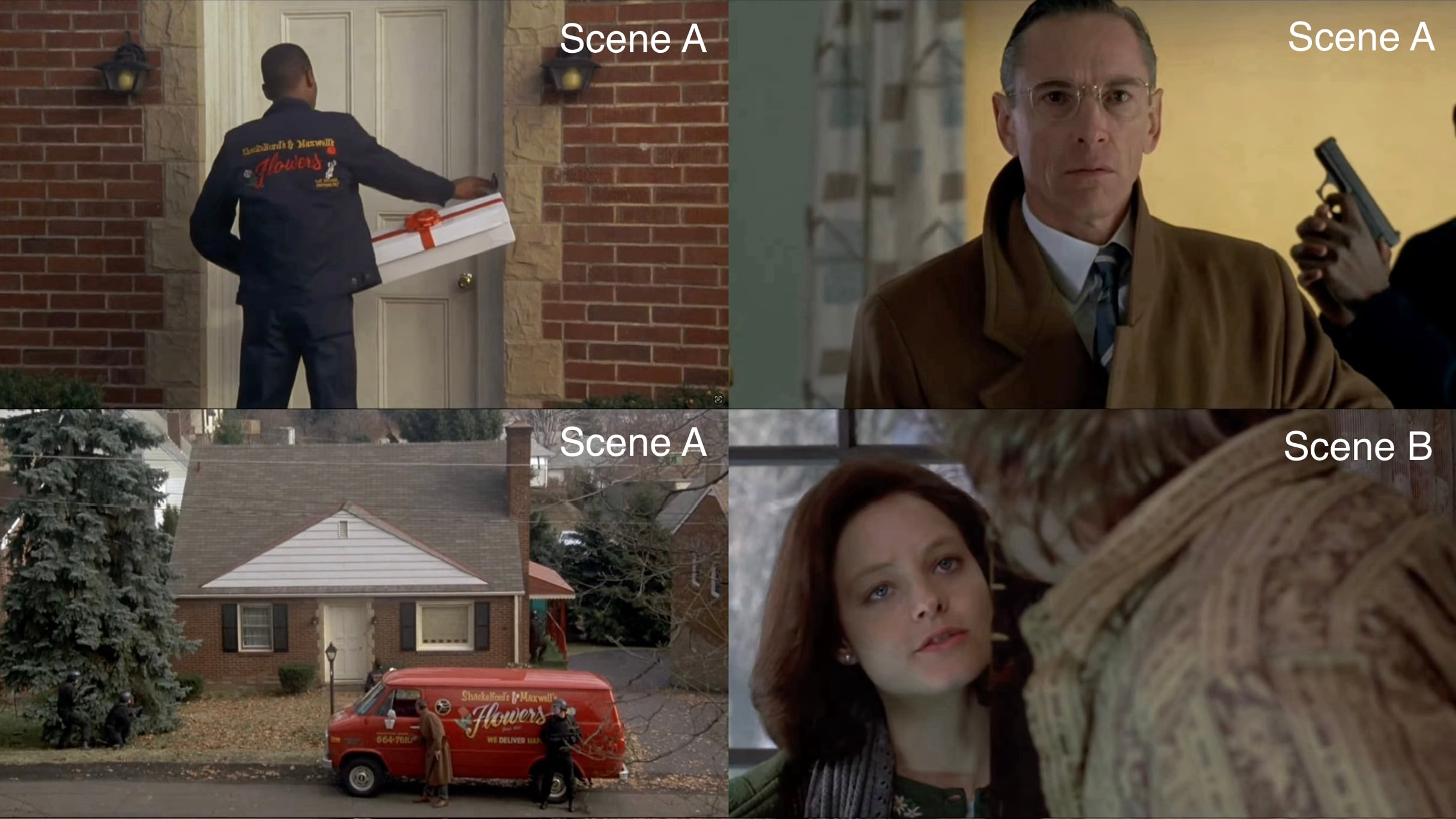
Editorial parallel suspense: law enforcement approach versus interior interview tension
Reference still illustrating parallel suspense structure—The Silence of the Lambs style cross-cutting.

Contrast — the meaning is in the gap

The two scenes need not be simultaneous. They must be in thematic conversation. The cut argues: notice what these images share—or what separates them.

The Departed (2006) cross-cuts an undercover cop in the mob and a mob informant in the police. The editing is often about moral equivalence: two men doing the same job for opposite sides, each holding information that could destroy the other.

The contrast is situational and moral, not merely visual. The cut is what keeps both men in mind at once and lets the audience feel the vertigo of their symmetry—best when the link is felt, not over-explained in dialogue.

Temporal fragmentation — when time is the material

Dunkirk (2017) runs three timelines at different scales—one week on the beach, one day at sea, one hour in the air—cross-cut until they converge. The structure is among the most formally ambitious uses of the device in recent cinema.

The audience may experience the beach before fully grasping how events at sea caused them. Characters who seem dead can reappear alive because another thread has not reached that moment yet.

Withholding across threads is the engine: each cut adjusts what the audience knows relative to each storyline until convergence makes the map legible.

Translating a Director's Style Into Structure

The three modes map to three structural problems. Naming the problem clarifies every downstream decision.

Simultaneity = a pacing problem

Ask how fast threads converge and when to cut to sustain versus release tension. The exit point of each scene is the lever: cutting before partial resolution suspends; cutting after releases—sometimes deliberately before the next scene rebuilds from a higher baseline.

Contrast = a meaning problem

Ask what relationship the audience should discover and how they will find it. Shared gesture, composition, or sound across the cut supplies connective tissue; without it, juxtaposition reads as arbitrary structure instead of designed theme.

Temporal fragmentation = information management

Ask what each thread reveals and withholds, and when convergence makes everything readable. You need the full map of threads before writing any one thread—each scene depends on what the audience already knows from the others.

In each case, cross-cutting logic should be settled before scenes are fully written. The cut is not a late add-on—it is structural and shapes everything downstream.

Cross-Cutting in AI Video Generation

In traditional editing, rhythm is discovered in the room. With generated media, structure has to come first.

Write cross-cutting logic as a beat sheet before generating clips: name threads, define the relationship—simultaneous, contrasting, or temporally fragmented—and map the cut order (A, B, A, C, B, A) as an editorial skeleton.

Generate order does not matter. With multi-second clips you can produce each thread complete, then assemble to the beat sheet in post. Generate each clip knowing its exit state when the cut falls—structural thinking first, production by thread, assembly last.

More Film Language

Frequently Asked Questions

What is cross-cutting in simple terms?

Editing that alternates between two or more scenes so the audience infers a relationship between them—often tension, moral parallel, or converging action.

Is cross-cutting the same as parallel editing?

They overlap heavily. Parallel editing usually stresses simultaneous action; cross-cutting is the broader family that also includes thematic contrast and fragmented time.

Why does exit point matter for simultaneity cuts?

Where you leave a scene before cutting away controls whether the audience stays suspended or gets partial relief—rhythm is built from those choices.

How should I plan cross-cuts for AI-generated footage?

Draft the cut skeleton first, generate each thread with clear end-states for each shot, then edit to the planned sequence—treat the beat sheet as pre-production, not an afterthought.

Storyboard threads and generate scenes with AI video tools