
Most edits are designed not to call attention to themselves. The camera changes angle, the story moves forward, and viewers accept the transition. A match cut works differently: it stays fluid, but its job is to make the link between two shots meaningful.
What It Is
A match cut is a transition between two shots linked by a shared visual element, action, or sound. The shots may sit in different places, eras, or narrative worlds—but something carries across the edit and binds them.
That connection is the real content of the edit. A match cut does not only move the viewer from one image to the next; it suggests the two images belong in relation to each other.
Match cuts often compress time, carry psychological association, or create a conceptual link between otherwise separate images. Those uses overlap, but separating them helps you plan what the cut should accomplish.
Collapsing Time
One of the most efficient uses is to jump across time while preserving continuity. A repeated gesture, object, or composition can make a large narrative leap feel motivated rather than abrupt.
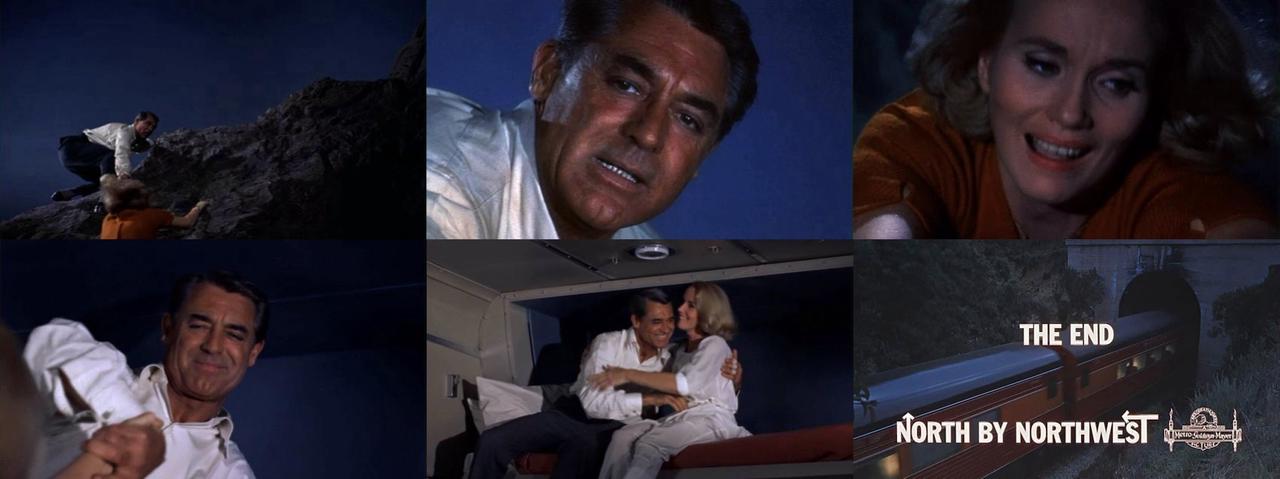
Near the end of Alfred Hitchcock's North by Northwest (1959), Roger Thornhill pulls Eve Kendall up from the edge of Mount Rushmore, and the film cuts directly to him pulling her up into a train bunk. The movement continues almost seamlessly while the story leaps into a new, intimate phase.
The match on action does more than save time. It encourages viewers to feel continuity in movement and emotional direction: danger gives way to intimacy, yet the gesture makes both moments feel part of the same narrative flow.
Transferring a Psychological State
A match cut does not have to be visual. It can work through sound—one noise carrying the audience from one reality into another.
Apocalypse Now (1979) opens with a famous sound match: helicopter rhythm blends into a ceiling fan above Captain Willard's bed in Saigon. Walter Murch described building an intentionally dreamlike helicopter presence before resolving the sound toward the room.
What matters is not only acoustic similarity. The transition suggests Willard's mind stays saturated by war. Physically he is elsewhere, but the sound makes that separation feel psychologically unstable before dialogue explains anything.
Making an Argument
The most ambitious match cuts hinge on formal resemblance that invites comparison—shared shape, posture, rhythm, or structure—and ask the audience to infer what that resemblance means.
Squid Game (2021) uses repeated framing and visual similarity so viewers read different people in different places as bound by the same underlying condition. The effect is less about spatial continuity than equivalence.
Used this way, the match cut becomes argumentative. It does not merely say one thing follows another; it proposes that two distinct moments should be understood together.
The Discipline It Requires
What separates an effective match cut from a decorative one is whether the connection produces meaning. Graphic resemblance is easy to create and easy to overvalue.
The important question is what viewers understand by linking these shots that they would not grasp from either shot alone. If the answer is only visual similarity, the cut may be elegant but limited. If it reveals continuity, entrapment, thematic likeness, or emotional equivalence, the edit is doing narrative work.
Pixar's Up (2009) uses gentle sonic and visual matches in its opening montage so one life moment flows into the next—showy less than precise, but the principle holds: the cut carries emotional texture across the transition.
Why It Matters as a Thinking Tool
The match cut is worth studying as a way of thinking about storytelling. To find one, ask what two moments share—what visual or sonic element can travel across the cut and make the transition meaningful rather than merely efficient.
That question reaches beyond editing. Stories often hide continuity beneath the surface—emotion, structure, memory, or theme. A match cut can make that hidden continuity visible.
The bone and the satellite. The fan and the helicopter. The hand from danger and the hand into safety. In each case the edit proposes a relationship. That is why a match cut can feel less like a splice than a thought.
Demo: Rhythmic Cuts & Motion Continuity
Placeholder demo clip illustrating sharp, legible transitions—use it to study how motion and rhythm can bridge shots.
More Film Language
Frequently Asked Questions
What is a match cut in simple terms?
It is an edit between two shots that share a visual, action, or sound element so the transition feels continuous while linking ideas, time, or psychology.
Is a match cut the same as a jump cut?
No. Jump cuts often remove time within similar framing and feel visibly discontinuous. Match cuts emphasize continuity or meaningful linkage across different shots.
Can a match cut be only sound-based?
Yes. Sound bridges—matching rhythm, texture, or motif—can carry meaning across scenes just as graphic or action matches do.
What makes a match cut weak?
When resemblance is arbitrary and the audience gains no new insight. Strong match cuts clarify relationship, theme, or emotion; weak ones only show clever visuals.