
Something feels off when motion suddenly lurches between states. That friction is not always a mistake. In film language, that is often a jump cut doing its job.
The Edit That Refuses to Hide
Most editing techniques try to disappear so viewers forget footage is assembled. A jump cut does the opposite: it keeps viewpoint similar and removes time from the middle.
The subject snaps forward and the seam is visible. It is the cut that cannot pretend not to be a cut.
From Accident to Deliberate Language
Early jump-cut effects appeared when Georges Melies had a camera interruption and discovered objects could vanish between frames.
Later, continuity-focused cinema treated visible cuts as failure. Jean-Luc Godard reversed that assumption in Breathless, using jump cuts as intentional form.
The visible cut became a statement: this is a made film, not seamless reality.
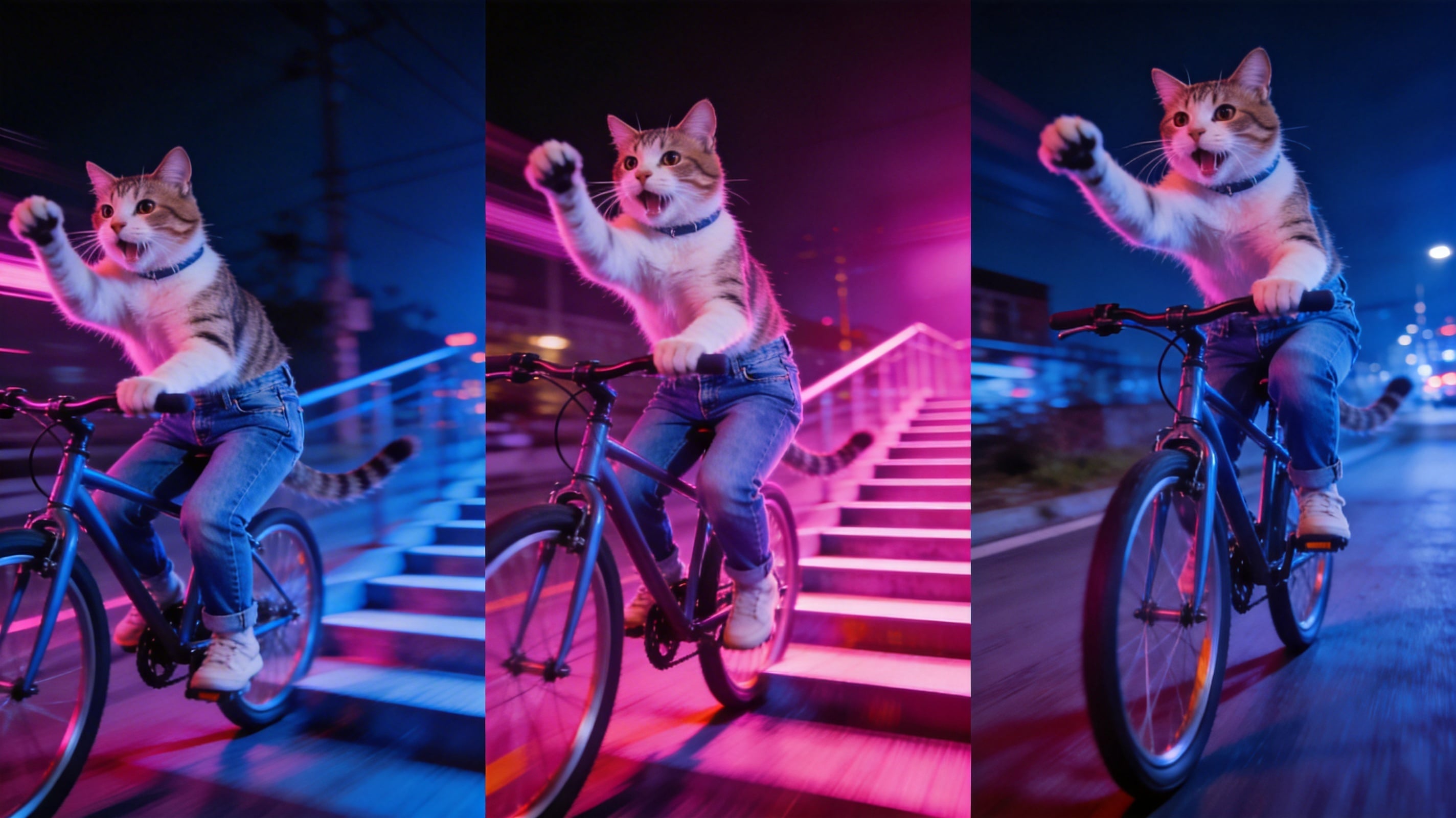
Jump Cut Demo Clip
A bike-riding cat in jeans with hard temporal jumps. Each edit shifts perspective to keep the cut legible.
How Jump Cuts Feel in Different Films
As paranoia (GoodFellas)
Rapid discontinuities fragment Henry Hill's final day and mirror mental collapse.
As horror (The Ring)
Abrupt temporal gaps become a scare device by denying smooth viewer tracking.
As character arc (Juno)
Jump cuts compress time gently to show emotional and physical transition.
As dissociation (Trainspotting)
Editing rhythm replicates stimulant perception where time feels fractured.
As loss of self (Perfect Blue)
Escalating jump cuts blur reality boundaries and transfer confusion to viewers.
What the 30-Degree Rule Explains
Continuity often needs a camera angle change of at least 30 degrees between adjacent shots. Smaller shifts can feel like a spatial jerk.
A jump cut uses that perceptual disruption intentionally: instability is temporal first, not merely bad camera coverage.
A Jump Cut Needs Motivation
A strong jump cut always does narrative work, such as anxiety, intoxication, growth, or disorientation.
If there is no clear answer to what the gap is doing, audiences read it as accidental editing rather than expressive form.
More Film Language Reads
Frequently Asked Questions
What is a jump cut in simple words?
It is a cut that removes time within similar framing, creating a noticeable visual jump.
Is a jump cut always a mistake?
No. It can be a deliberate choice to convey urgency, unease, compression, or fractured perception.
How does the 30-degree rule relate to jump cuts?
When adjacent shot angles are too similar, the edit can feel like a jerk; jump cuts use that effect intentionally.
When should editors avoid jump cuts?
Avoid them when seamless continuity is the priority and no thematic reason justifies visible disruption.