
What POV Actually Means
Point of view, in its most basic definition, is the position from which a story is told. But that definition hides what makes POV interesting as a technique: it is not primarily about where the narrator stands. It is about what the narrator knows, what they misunderstand, and what they cannot see — including about themselves.
In fiction, POV is fundamentally epistemological. It governs the flow of information between the story and the reader. A first-person narrator tells you exactly what one consciousness has access to — its memories, its misreadings, its convenient omissions. A third-person limited narrator gives you a single character's interior experience without the 'I'. An omniscient narrator moves freely between minds. Each of these is a set of rules about what can be known.
Film talks about POV almost entirely in optical terms: where the camera is placed, what angle the shot is from, whether the frame represents what a character physically sees. A camera placed at eye level behind a character's shoulder tells you where the camera is. It tells you almost nothing about what the character understands, suspects, or has got wrong.
The gap: Between epistemological POV and optical POV — that is where the most interesting problems in cinematic storytelling live.
The Translation Problem, Proved by the Adaptations
Mario Vargas Llosa's The City and the Dogs (1963) shifts narrative perspective mid-scene, sometimes mid-paragraph, without announcement. You are reading what you believe to be one character's account and realize gradually that the voice has changed. The reader reconstructs whose reality they have been inhabiting after the fact.
William Faulkner's The Sound and the Fury (1929) takes this further. Its first section is narrated by Benjy, a character who cannot distinguish between past and present, whose account moves freely across decades without temporal markers. He does not know he is confused. The reader is inside a consciousness that does not organize experience the way consciousness is supposed to — and the disorientation is the content.
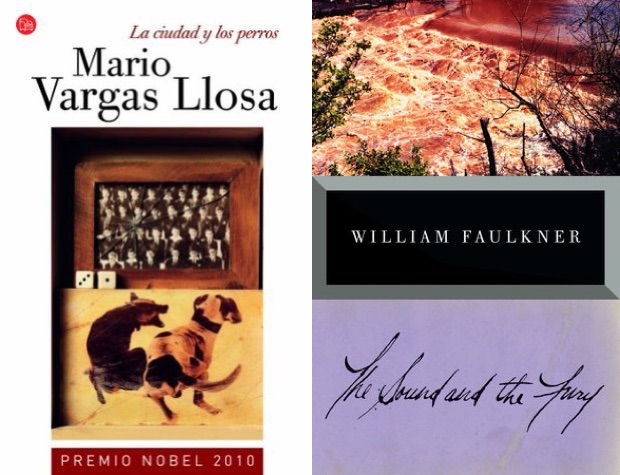
Francisco Lombardi's The City and the Dogs (1985) is, by most accounts, a solid film. What it is not is the novel. Vargas Llosa's shifting, multiple, unannounced perspectives — described by one critic as creating 'a multiform, collective subjectivity' — were replaced with a simplified, linear narrative structure. The technique that gives the novel its identity is entirely absent.
The Sound and the Fury has been adapted twice, from opposite directions. Martin Ritt's 1959 version chose strategic avoidance, building the film around the only section narrated from an objective viewpoint. James Franco's 2014 version attempted genuine fidelity, using handheld cameras and fragmented editing to approximate Benjy's disorientation. Critics found the attempt admirable and the result inadequate.
What neither film could solve is the same problem: Benjy's narration works because it is invisible in its wrongness. Film cannot replicate this because the camera always anchors the viewer in physical space and time. Even handheld, even fragmented — a camera placed somewhere is a camera placed somewhere. It cannot be inside a consciousness that does not know where it is.
What Film Has Actually Done With POV
Three films mark the outer edges of what cinema has tried: a literal translation, a structural workaround, and an ambient immersion. Each reveals something different about how far the camera can be pushed toward a character's interior.
The Failed Experiment
Lady in the Lake (1947): first-person optical POV sustained for an entire feature — and why it produced alienation instead of intimacy.
The Structural Solution
Rashomon (1950): Kurosawa's four contradictory accounts turn architecture itself into POV.
The Ambient Approach
Black Swan (2010): Aronofsky keeps the camera close to Nina and refuses to tell you what is real.
The Failed Experiment: Lady in the Lake
In 1947, director and star Robert Montgomery attempted the most literal possible translation of first-person literary narration into cinema. Lady in the Lake, an adaptation of Raymond Chandler's Philip Marlowe novel, was shot almost entirely from Marlowe's optical point of view. The camera became his eyes. Other characters looked directly into the lens when speaking to him. Marlowe himself appeared only in mirror reflections.
The film was the only major Hollywood production ever attempted this way, and it has never been repeated for an entire feature. The failure was instructive: first-person optical POV, sustained for an entire film, produces not immersion but alienation. Audiences found it exhausting. The actors, with no body to play against, became stiff. The camera's smooth, stabilized movement bore no resemblance to actual human vision, which is darting and selective.
What the experiment revealed is that optical first-person POV does not produce identification — it produces a kind of floating dissociation. You know whose eyes you are supposed to be seeing through, but the knowledge does not create the intimacy that literary first-person does. It creates a camera with a name.
The Structural Solution: Rashomon
Akira Kurosawa's Rashomon (1950) is the closest cinema has come to the epistemological ambiguity of literary POV — and it achieves this not through camera placement but through structure.
The film presents four contradictory accounts of the same event: a samurai's death, witnessed and narrated by a bandit, the samurai's wife, the samurai himself speaking through a medium, and a woodcutter who claims to have observed everything. Each account is presented as a flashback narrated by its respective witness. None of the accounts agree. The film offers no resolution and no authoritative version.
What Kurosawa understood was that the camera's involuntary truthfulness could be weaponized rather than evaded. Within each account, the camera shows you what that narrator claims happened — and it shows it with the full authority of photographic reality. The technique's power comes from the contradiction between accounts, not from any single account being visually unreliable.
Kurosawa did embed subtle stylistic differences between the four narrations — different editing rhythms, different use of POV shots, different proportions of close versus distant framing. But the film's epistemological effect comes from its architecture, not its cinematography.
The Ambient Approach: Black Swan
Darren Aronofsky's Black Swan (2010) takes a third approach. The film does not confine itself to a single optical POV, and it does not use a structural repetition of the same event. Instead, it creates ambient subjectivity: the camera remains close to Nina throughout the film, following her with handheld intimacy, and the visual fabric of the film gradually becomes saturated with her deteriorating perception without ever formally declaring itself subjective.
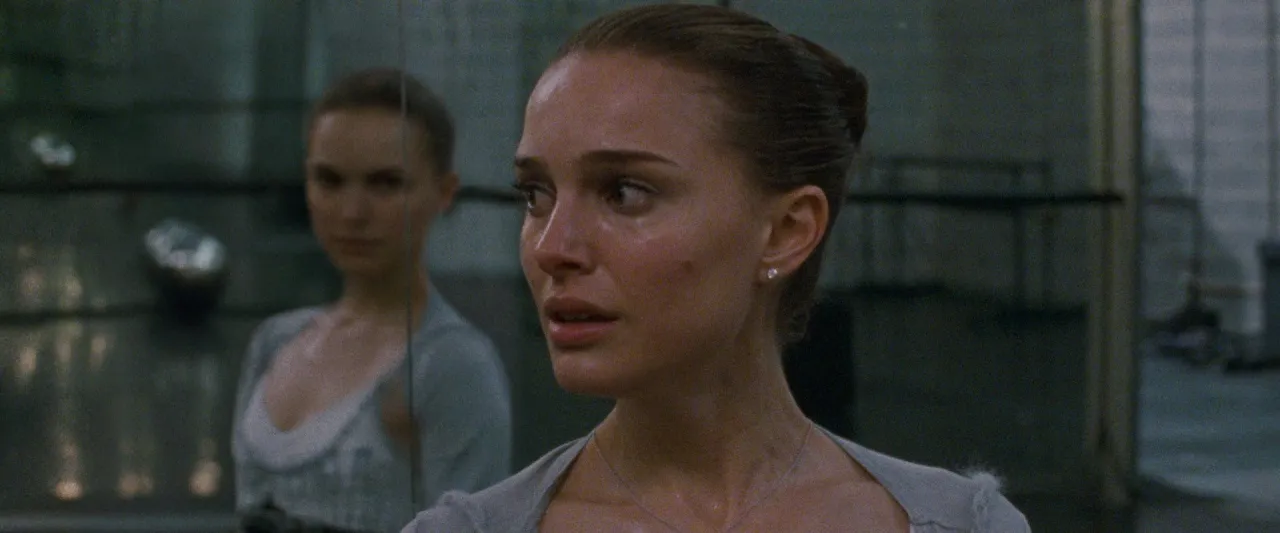
The hallucinations Nina experiences are shown with the same visual authority as everything else. When she sees a face that is not there, the camera shows it. When she imagines something that did not happen, the camera presents it as though it did. The audience is not told which scenes are reliable and which are not — they are left in the same epistemological position as Nina herself, unable to distinguish interior from exterior experience.
This works because Aronofsky does not try to signal unreliability through visual style. He simply refuses to provide the cues that would let the audience safely distinguish real from hallucinated. The camera's authority is used against the audience rather than for them.
The cost is that Black Swan requires a character whose psychology is pathological. Ambient subjectivity works when the reason for the unreliability is the character's mental state — when hallucination is the content of the film, not a technique applied to ordinary experience.
What Film Can Do That Literature Cannot
There is one thing a camera can do that a written first-person narrative cannot: it can show you what a body looks like from the outside while you are inside it. A written narrator can describe their own physical experience — pain, exhaustion, desire — but they cannot show you their own face.
Black Swan uses this contradiction deliberately. The mirror scenes show Nina what she looks like from the outside at the precise moments when her self-perception is most distorted. The camera shows the audience both Nina-as-she-is and Nina-as-she-sees-herself, sometimes within the same shot. The doubling is only possible because film can simultaneously be inside and outside a subject.
The involuntary disclosure that makes first-person optical POV a failed experiment also makes possible a kind of psychological portraiture that literature has to work much harder to achieve. You cannot hide a body. You cannot hide a face. The camera finds the truth of a performance whether the director wants it to or not — and the best directors know how to use that involuntary revelation rather than fight it.
POV in AI Video Generation
In AI video generation, POV is almost entirely understood as a camera instruction: first-person view, eye-level, over-the-shoulder. These are legitimate and useful, but they describe the optical dimension of POV only.
The deeper POV question — whose reality are we constructing, and what does that character not yet know — has to be resolved at the structural and scripting level before generation begins. A scene generated from a character's optical point of view will still look like a camera placed at head height. The epistemological texture — the character's incomplete knowledge, their misreadings, the things they have not noticed yet — has to be built into what the scene shows and, more importantly, what it withholds.
The most useful way to think about POV in generation is not as a camera setting but as an information management decision: what does the audience know at this point, what does the character know, and where is the gap between them? That gap is where narrative tension lives.
Aronofsky's approach in Black Swan — placing the camera consistently close to the protagonist and refusing to provide reliable cues about what is real — can inform a generation brief. Not as a literal instruction ('generate a first-person shot'), but as a tonal and structural commitment applied across every scene in the sequence.
Manage Information, Not Lenses
Before writing camera prompts, map what the character knows at each beat versus what the audience knows. The asymmetry is the story.
Commit to a Contract
Decide whether the audience can trust what they are seeing, and hold that commitment across the entire sequence — not one shot at a time.
Use the Camera's Involuntary Truth
Let the camera reveal what the character cannot hide. The best POV moments use the body and face as secondary narrators.
A Director's Checklist for POV in AI Video
Treat this as a pre-generation pass. Answering these five questions before you prompt a model will change the output more than any lens choice.
Whose reality is this scene?
Name the character whose consciousness frames the sequence. Even 'none / omniscient' is a choice — make it explicit so the generation stays consistent.
What does the character not know?
List the information the character is missing at this moment. Each gap is a generation opportunity — something the frame should imply or withhold.
What does the audience know that the character doesn't?
The gap between those two maps is where suspense, irony and discovery live. POV is the dial that controls how wide that gap stays.
Is your camera placement honest to the POV?
Optical first-person is rarely the right answer. Ambient proximity — the camera close to the character but not inside their eyes — almost always reads better.
Are you holding the contract across the sequence?
POV breaks when cues drift from shot to shot. Define the rule (what we see, what we withhold) and apply it consistently across every generation pass.
Keep Exploring Film Language for AI Video
Frequently Asked Questions
Is POV in film the same as POV in literature?
No. Literary POV is primarily epistemological — it controls what can be known. Cinematic POV is mostly optical — it describes where the camera sits. The real creative work is bridging that gap.
Why does sustained first-person POV usually fail in film?
Because the camera's smooth, mechanical gaze has no resemblance to human vision, and because identification in cinema depends on seeing a body act, not on pretending to be that body. Lady in the Lake is the textbook case.
How did Rashomon solve the POV problem?
Structurally, not optically. Kurosawa shows the same event four times from four narrators. The audience's disorientation comes from the contradictions between accounts, not from any single image being visually unreliable.
What does Black Swan teach AI video creators?
That POV can be ambient rather than literal. Keep the camera close to the protagonist, refuse to signal what is real, and let the audience share the character's uncertainty — a directive that shapes every scene, not just one shot.
How do I apply this when prompting an AI video model?
Define POV as an information contract before writing camera prompts. Decide whose reality you are generating, what the character does not know, and how long you will hold that gap. Then translate those decisions into consistent framing, lens and tonal choices across the sequence.
Direct POV-Aware AI Video with NewFace AI
Stop thinking of POV as a camera setting. Build it into your script, character, and scene decisions — and let our Agent keep the contract consistent across every shot.