
The hardest scene to film is an empty one. Without characters or lines, bad coverage feels like wallpaper; precise prompts become atmosphere—felt before it is named. This walkthrough uses a deserted East Asian entertainment district after rain: neon, wet asphalt, closed shutters, nobody home. Five shots. No people.
The Scene: What We're Working With
Before any shot list, lock the world. Vague scene prompts yield vague footage. This foundation sets mood, color, texture, and physical detail for every shot that follows.
Master scene prompt
A deserted city street at night in a dense neon-lit East Asian entertainment district after rainfall. Narrow street with layered vertical shop signs, closed metal shutters, reflective glass storefronts, overhead utility cables, vending machines, wet asphalt, puddles, curb markings, traffic signals in the distance, faint steam drifting from a side vent, soft atmospheric haze, no pedestrians, no foreground vehicles. Realistic cinematic night lighting, glossy reflections, rich but believable neon bloom, deep perspective, urban solitude, restrained film grain, high detail, grounded photorealism.
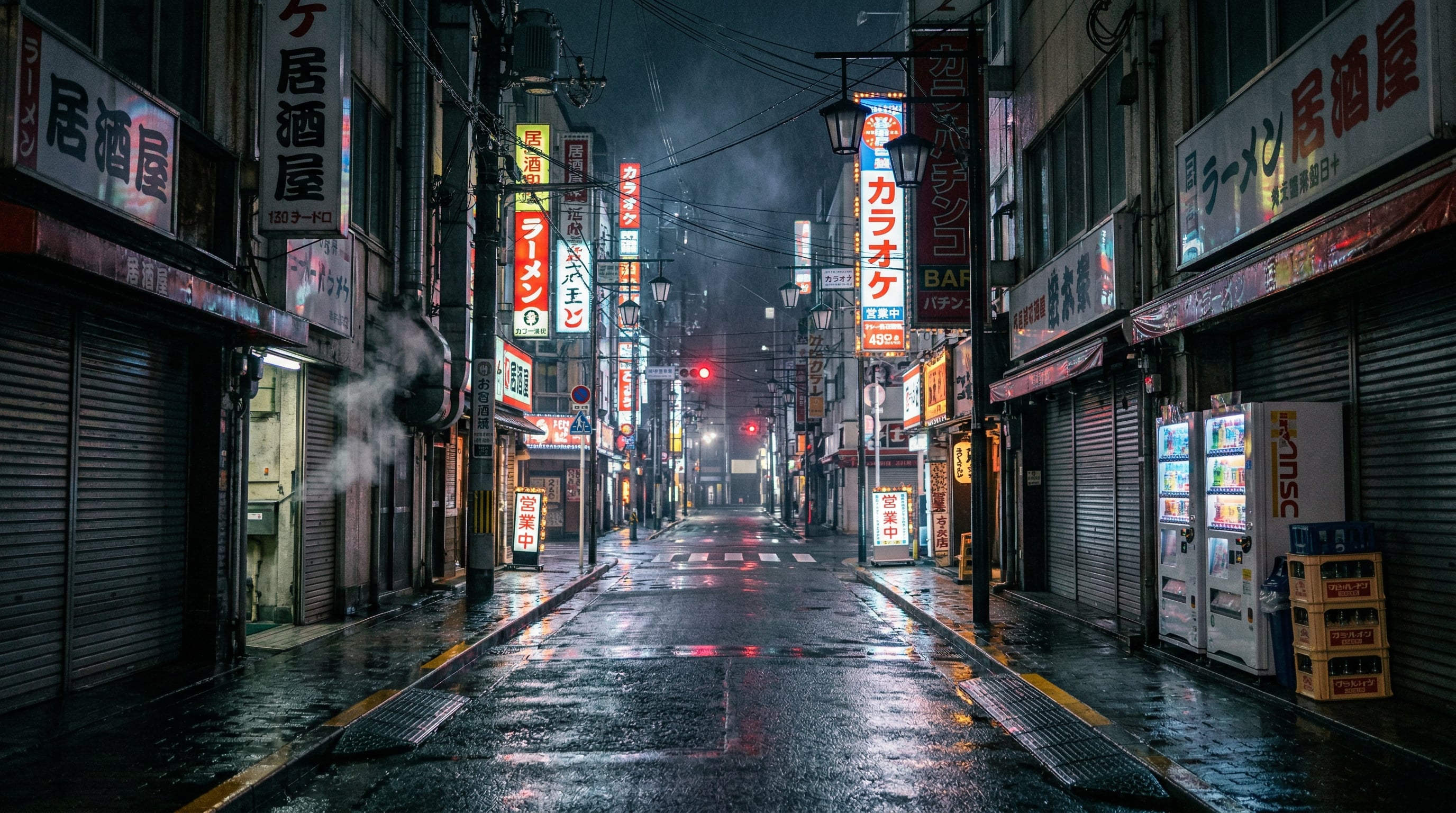
Decisions worth flagging in the scene prompt
"After rainfall" — residue, not chaos
Not during a storm or light drizzle: after. The street is wet but the event has passed. That changes emotional temperature—stillness, reflection, the sense something just ended. Puddles mirror instead of disturb.
"No pedestrians, no foreground vehicles"
Urban generators default to crowds and cars. If you want emptiness, say it explicitly or the frame will populate itself.
"Rich but believable neon bloom"
Neon drifts into plastic oversaturation easily. Believable keeps light expressive yet grounded—behavior that could belong to a real place.
"Restrained film grain"
Grain is material texture, not a style sticker. Too much advertises look instead of atmosphere; restrained keeps the image tangible.
Shot #1 — Moving Into the World
Camera
[Camera] slow cinematic push-in at eye level, 35mm lens feel, smooth stabilized forward dolly, natural parallax, locked horizon, no handheld shake
Action
[Action] light rain continues to fall, puddle reflections shimmer subtly, one distant sign flickers intermittently, steam drifts slowly across part of the frame
Mood / Texture
[Mood / Texture] realistic cinematic night exposure, glossy reflections, rich but believable neon bloom, quiet urban solitude, restrained film grain, photorealistic
Push-in at human scale: entering the street rather than floating above it.
Eye level, 35mm feel, and forward motion place the viewer as someone arriving inside the space—not observing from above or gliding through it.
Natural parallax separates foreground and background as the dolly advances; that depth shift is what keeps the move cinematic instead of a digital zoom. Flicker and steam add just enough life so motion does not feel pasted onto a still.
Shot #2 — Reading the Space Sideways
Camera
[Camera] slow lateral tracking shot moving left to right, 50mm lens feel, controlled dolly movement, stable vertical lines, locked horizon, smooth pace, no shake
Action
[Action] reflections slide across glass and metal surfaces as the camera moves, a vending machine glows steadily, neon highlights ripple in puddles, faint rain continues
Mood / Texture
[Mood / Texture] observational, precise, cinematic realism, cool urban color separation, reflective wet surfaces, quiet nocturnal atmosphere, subtle grain
Lateral track: scan the environment after you have stepped in.
Moving from a 35mm to a 50mm feel is deliberate—more neutral, less spatially expressive, better for observation than immersion.
Stable vertical lines matter on a lateral move: signs and building edges sweep through frame; if verticals wobble, the shot reads handheld and breaks the controlled tone. A steadily glowing vending machine anchors the eye amid sliding reflections.
Shot #3 — Coming Down Into It
Camera
[Camera] high-angle crane shot descending slowly with a slight forward drift, 28mm lens feel, elegant controlled motion, smooth vertical-to-forward movement, stable horizon
Action
[Action] traffic lights glow in the distance, rainwater ripples near the curb, steam lifts from one vent, neon reflections broaden across the wet street as the camera descends
Mood / Texture
[Mood / Texture] lonely, suspended, cinematic city-night mood, soft haze, realistic neon bloom, deep perspective, photoreal, atmospheric clarity
Crane down with forward drift—less elevator, more approach.
Pure crane-down can feel mechanical; adding slight forward drift makes gravity read as intention.
28mm is wider than the prior shots because the frame must hold layout and scale from above; a tighter lens would compress the descent.
As the camera lowers, reflected neon spreads across the wet street—the city reveals itself through its own surface.
Shot #4 — Getting Intimate With the Ground
Camera
[Camera] extremely low-angle glide just above the wet street surface, 24mm lens feel, smooth forward tracking, measured pace, subtle perspective exaggeration, stable motion
Action
[Action] raindrops strike puddles, neon reflections distort continuously in the water, distant light sources create moving bands across the wet ground, a thin wave of steam crosses the lower frame
Mood / Texture
[Mood / Texture] tactile, immersive, glossy rain reflections, saturated but realistic neon, intimate urban stillness, cinematic texture, photorealistic night atmosphere
Illustrative clip (lateral motion); replace with your low-angle wet-pavement render for the full tactile effect.
Extremely low angle plus 24mm exaggerates perspective: foreground swells, distance stretches, pavement nears abstraction. Location becomes texture.
Tactile is not a vague mood word—it asks the model for physical qualities: damp, cold, glossy, close enough to touch.
Steam shifts role here: background haze in earlier shots becomes foreground material at this height.
Shot #5 — Tilting the World
Camera
[Camera] slow cinematic push-in with a controlled Dutch angle, camera tilted approximately 20 degrees clockwise, eye-level height, 35mm lens feel, smooth stabilized forward movement, deliberate pace, no handheld shake, maintain the tilted horizon consistently throughout the shot
Action
[Action] light rain falls steadily, puddle reflections shimmer and distort, one distant neon sign flickers intermittently, steam drifts slowly across the tilted frame, distant traffic lights glow softly in the background
Mood / Texture
[Mood / Texture] uneasy, tense, subtly disorienting, realistic cinematic night exposure, glossy wet reflections, believable neon bloom, urban isolation, restrained film grain, photorealistic
Same street as Shot #1 in spirit—horizon tilt changes the emotional read.
The forward move echoes Shot #1: similar height and lens feel, same street—but the Dutch angle makes emptiness feel unstable without adding subjects or props.
That isolates one directorial decision: how horizon tilt reframes atmosphere when nothing else in the world changes.
The phrase "maintain the tilted horizon consistently throughout the shot" matters—without it, video models often drift in and out of the angle, weakening the effect.
Keep going
Frequently Asked Questions
Why specify "no pedestrians" in AI video prompts?
Urban models default to populated streets. Explicit negatives reduce unwanted extras in foreground and midground.
Why break prompts into Camera / Action / Mood blocks?
It mirrors how crews think on set and gives the model separate handles for geometry, temporal change, and photographic character.
Do I need five shots for every empty scene?
No. This sequence is a teaching ladder: establish entry, read space, change scale, touch texture, then reframe meaning with a single camera choice.
Why end on a Dutch angle?
It demonstrates that one committed horizon tilt can shift emotional logic without changing location or cast—useful for prompt demos and real cuts alike.